I received an email (Question #4) asking, “What exactly is ‘breaking through’?” (see The Adaptable Brain)
It’s really quite simple. “Breaking through” is exactly that--breaking through the ice.
In The Adaptable Brain, Keri and Taco and I were riding the snow machine down the Yukon River. It had been warmer weather, and the snow had turned slushy--and yet we were barreling down the Yukon River on a huge, heavy piece of machinery. I didn’t trust the ice. I leaned forward and said in Taco’s ear, “If we break through, you push off and roll away and don’t stop--no matter what.”
There is good reason for those instructions. Every year, people push the limits and get on the ice too early (before it has frozen thick enough) or stay on too late (long after it has started to melt). And every year, someone falls through the ice...and oftentimes drowns or simply disappears.
Last year (maybe the year before), we lost a recently retired school board member who was driving his snow-go down the river with his young grandson, when he suddenly broke through. His grandson was sitting in front, and the old man grabbed the boy and threw him towards the bank. But the man couldn’t save himself. The boy survived, but his grandfather drowned.
In school, the kids have to sit through a survival safety course every year. One of the things they are taught is when walking on the ice, carry a big stick and hold it sideways. That way, if you fall through the ice, the stick will hopefully stop you from going all the way under, and you can use it to crawl back out. The trick is to not let go of the stick. The guy I heard lecturing said that the first time he broke through ice, he immediately let go of his stick so he could try to catch himself with his hands. Reflexes tend to take over, and they aren’t always right.
If you break through while riding on the river, you are to push off, try to land sideways, and roll away from the hole. Don’t get up and run--just roll. Your weight is distributed farther, and there is less chance of breaking through again. That is what I was telling Taco to do if we should break through.
We had just spent an hour or so digging our snow machine out of slushy snow. And I just wanted to make sure he knew what to do if we ended up breaking through the ice underneath.
Life in the tundra...on the banks of the Yukon River...just below the Arctic Circle...can get crazy at times.
Showing posts with label snow machine. Show all posts
Thursday, May 26, 2011
Wednesday, May 25, 2011
Q & A
There have been a few questions sent my way that I’ve been wanting to answer. Things have been insanely busy lately so I haven’t had a moment to spare, but we have a lull for a few days, so I’m finally able to get to them.
Basically, the questions are:
1. How the blazes do we get big things like snowmobiles and four wheelers into the village?
2. And what about flammable stuff like gasoline?
3. How do the locals afford such things?
4. What does it mean to “break through”? (See The Adaptable Brain) Because the answer to question 1 got kind of lengthy, question 4 will be answered in my next entry (hopefully tomorrow).
QUESTION #1
In the bush, travel, and even something as simple as mailing a letter, can be tricky. Getting something like a snowmobile, four-wheeler, refrigerator, or a piece of furniture to a village can be really tricky.
The easiest and most fun way to get a snowmobile is to buy one from a nearby village. (“Nearby” translates to anywhere than can be reached within a day’s snow machine ride.) That way, all you have to do is find a buddy with cabin fever, stock up on supplies, jump on the back of his snow machine, and off you go. Road trip! Just don’t forget the most important thing to take (besides extra gas)--a GPS locater. When you get away from the villages, it is very easy to get completely turned around. If it weren’t for our GPS, Keri would still be wandering around in the tundra somewhere. And it doesn’t just happen to us white guys. It’s no coincidence that Alakanuk means “Wrong Way” in Yup’ik.
Once you finally get to where your new machine is, you’ll probably have to spend the night. Since there is no such thing as a motel in the villages, you can usually arrange to stay at the school. Just throw your sleeping bag on the floor, and snooze. Ya right. Good luck with that. School floors are not built with comfort in mind.
After a long sleepless night, you crawl out of your bag, all bleary-eyed...and you and your buddy, who is no longer cabin crazy, just sleep-deprived and swearing to never do this again, climb on your machines for the long ride home. But this time you are driving your very own snowmobile!
“But,” you ask yourself, “how the blazes do the snow machines, four-wheelers, refrigerators, pieces of furniture get to the villages in the first place?!” That is an excellent question, and the answer is simple: magic. That’s what it seems like anyway.
I’ve been told that sometimes stuff is brought to the village by barge, but I haven’t actually seen it happen. The barge simply waits...and waits...and waits for spring thaw. Then they wait for all the ice to clear out of the rivers. THEN they can make the trip to the Bering Sea and up the Yukon...Kuskokwim...Kobuk...Rivers to the villages.
But most of the big stuff is flown in from Anchorage--and that’s harder than it sounds. In most villages (including ours), the airstrip is too short to handle anything but small bush planes—and those planes are too small to carry anything big. So, the snow machine, four-wheeler, refrigerator, piece of furniture...is flown into a hub. These hubs are villages with a longer airstrip, and most of them even a shack for people to wait in until their plane comes. They are quite high tech there—they even have a bathroom and coffee maker. (All we have in our village is a short strip of gravel. You just hang out on the side of the airstrip, waiting for the plane to show. Although, since they give you a personal call to let you know they’re on their way, the wait is usually pretty short. But more on that later.) We are lucky, because our hub is Emmonak (usually called plain Emmo with long E and O sounds)--and it’s only 20 minutes away from Alakanuk.
So--for us, the big ticket item is flown into Emmo and then picked up from there. If it’s during the summer, one of the locals takes their boat up the Yukon to Emmo, picks it up and brings it back to the Alakanuk dock. If it’s winter, then a truck drives up the Yukon River, which is now an ice highway, to pick up the item and bring it back to the village.
QUESTION #2
As for gasoline, I am told that it is brought in by barge during the summer months. The village stocks up on enough gas to last through the coming winter. Since there are very few cars or trucks around here, most of what is driven is snow machines or four wheelers. These machines tend to get better gas mileage than most other vehicles, so the gas goes farther. And another thing is that most of the driving is done close to home. Back in California, my husband used to drive about 50 miles to work each day. Here, a trip that long takes detailed planning and provisions--so there isn’t an awful lot of gas being used.
About three years ago, a neighboring village didn’t get their final gasoline order in on time, so they didn’t receive their last shipment. They were running out of gas by the time the winter was half over. The media got wind of it, and the whole thing became a circus. By the time it was over, some rich guy had shipped in a bunch of gas to Anchorage and then had it flown out to the village by bush plane. But usually, it’s just brought in by barge.
QUESTION #3
As for how the locals afford such “luxury” items as snow machines, four wheelers, and boats, first of all…these items are not luxuries; they are essential to survival. It’s not like most of the world where such things are used for recreation. Here, they are the only mode of local transportation. They are used to travel to other villages, to go hunting with, etc. Basically, snow machines, four wheelers, and boats have taken the place of the dog sled and are used in the way that other places use cars and trucks.
When it comes to affording it, that is a mystery--until you figure out the local economy. Much of the bush population lives by subsistence. That means they “live off the land” through hunting, fishing, berry picking, and so forth. They don’t have to pay much, if anything, for their housing or utilities. Some people have jobs (mostly with the schools), but most of them are on welfare. Plus, they all receive their annual PFD, or Permanent Fund Dividend; this is a lump sum that every Alaskan receives each year. It is usually $1000 to $2000 per person--but if you consider a family with 5 or 6 kids, that adds up to a lot of money. There are also cottage industries that go on too. People sell everything from jewelry to home brew (also called moonshine).
Question #4 will be answered next. (hopefully tomorrow)
Basically, the questions are:
1. How the blazes do we get big things like snowmobiles and four wheelers into the village?
2. And what about flammable stuff like gasoline?
3. How do the locals afford such things?
4. What does it mean to “break through”? (See The Adaptable Brain) Because the answer to question 1 got kind of lengthy, question 4 will be answered in my next entry (hopefully tomorrow).
QUESTION #1
In the bush, travel, and even something as simple as mailing a letter, can be tricky. Getting something like a snowmobile, four-wheeler, refrigerator, or a piece of furniture to a village can be really tricky.
The easiest and most fun way to get a snowmobile is to buy one from a nearby village. (“Nearby” translates to anywhere than can be reached within a day’s snow machine ride.) That way, all you have to do is find a buddy with cabin fever, stock up on supplies, jump on the back of his snow machine, and off you go. Road trip! Just don’t forget the most important thing to take (besides extra gas)--a GPS locater. When you get away from the villages, it is very easy to get completely turned around. If it weren’t for our GPS, Keri would still be wandering around in the tundra somewhere. And it doesn’t just happen to us white guys. It’s no coincidence that Alakanuk means “Wrong Way” in Yup’ik.
Once you finally get to where your new machine is, you’ll probably have to spend the night. Since there is no such thing as a motel in the villages, you can usually arrange to stay at the school. Just throw your sleeping bag on the floor, and snooze. Ya right. Good luck with that. School floors are not built with comfort in mind.
After a long sleepless night, you crawl out of your bag, all bleary-eyed...and you and your buddy, who is no longer cabin crazy, just sleep-deprived and swearing to never do this again, climb on your machines for the long ride home. But this time you are driving your very own snowmobile!
“But,” you ask yourself, “how the blazes do the snow machines, four-wheelers, refrigerators, pieces of furniture get to the villages in the first place?!” That is an excellent question, and the answer is simple: magic. That’s what it seems like anyway.
I’ve been told that sometimes stuff is brought to the village by barge, but I haven’t actually seen it happen. The barge simply waits...and waits...and waits for spring thaw. Then they wait for all the ice to clear out of the rivers. THEN they can make the trip to the Bering Sea and up the Yukon...Kuskokwim...Kobuk...Rivers to the villages.
But most of the big stuff is flown in from Anchorage--and that’s harder than it sounds. In most villages (including ours), the airstrip is too short to handle anything but small bush planes—and those planes are too small to carry anything big. So, the snow machine, four-wheeler, refrigerator, piece of furniture...is flown into a hub. These hubs are villages with a longer airstrip, and most of them even a shack for people to wait in until their plane comes. They are quite high tech there—they even have a bathroom and coffee maker. (All we have in our village is a short strip of gravel. You just hang out on the side of the airstrip, waiting for the plane to show. Although, since they give you a personal call to let you know they’re on their way, the wait is usually pretty short. But more on that later.) We are lucky, because our hub is Emmonak (usually called plain Emmo with long E and O sounds)--and it’s only 20 minutes away from Alakanuk.
So--for us, the big ticket item is flown into Emmo and then picked up from there. If it’s during the summer, one of the locals takes their boat up the Yukon to Emmo, picks it up and brings it back to the Alakanuk dock. If it’s winter, then a truck drives up the Yukon River, which is now an ice highway, to pick up the item and bring it back to the village.
QUESTION #2
As for gasoline, I am told that it is brought in by barge during the summer months. The village stocks up on enough gas to last through the coming winter. Since there are very few cars or trucks around here, most of what is driven is snow machines or four wheelers. These machines tend to get better gas mileage than most other vehicles, so the gas goes farther. And another thing is that most of the driving is done close to home. Back in California, my husband used to drive about 50 miles to work each day. Here, a trip that long takes detailed planning and provisions--so there isn’t an awful lot of gas being used.
About three years ago, a neighboring village didn’t get their final gasoline order in on time, so they didn’t receive their last shipment. They were running out of gas by the time the winter was half over. The media got wind of it, and the whole thing became a circus. By the time it was over, some rich guy had shipped in a bunch of gas to Anchorage and then had it flown out to the village by bush plane. But usually, it’s just brought in by barge.
QUESTION #3
As for how the locals afford such “luxury” items as snow machines, four wheelers, and boats, first of all…these items are not luxuries; they are essential to survival. It’s not like most of the world where such things are used for recreation. Here, they are the only mode of local transportation. They are used to travel to other villages, to go hunting with, etc. Basically, snow machines, four wheelers, and boats have taken the place of the dog sled and are used in the way that other places use cars and trucks.
When it comes to affording it, that is a mystery--until you figure out the local economy. Much of the bush population lives by subsistence. That means they “live off the land” through hunting, fishing, berry picking, and so forth. They don’t have to pay much, if anything, for their housing or utilities. Some people have jobs (mostly with the schools), but most of them are on welfare. Plus, they all receive their annual PFD, or Permanent Fund Dividend; this is a lump sum that every Alaskan receives each year. It is usually $1000 to $2000 per person--but if you consider a family with 5 or 6 kids, that adds up to a lot of money. There are also cottage industries that go on too. People sell everything from jewelry to home brew (also called moonshine).
Question #4 will be answered next. (hopefully tomorrow)
Labels:
Alakanuk,
bush planes,
economy,
questions,
snow machine,
travel
Friday, May 6, 2011
Spring Has Sprung!
Change is a-happenin’ up this way. Spring has Sprung!
The sun is back! During the winter, it would hardly show itself. Now it doesn’t leave. The other day, I got really sick, and was up all night--literally. I can now report that the sun pretends to go down about 1 AM--but the sky doesn’t actually get dark. By 4:30 AM the sun is on its way up again. I like this MUCH better than the winter when we hardly got any daylight at all. But it does reek havoc with the internal clock. Our poor bodies don’t know when it’s time for bed. I lay there at night, staring out at the still partially-lit sky, and wonder why I’m in bed when it’s not dark out yet. When I was a kid, I would fight going to sleep when it’s still light outside--and I still do. Some things never change.
And along with long daylight, we have warmer temperatures. It has been in the mid 30s every day for a couple weeks now. That means that the snow is beginning to melt—a lot. Instead of mounds of snow in the road, we now have mud and lakes. Snow boots have been traded in for big old rubber boots. We look like farmers. We’ve even been able to shovel off the boardwalk that goes around the teacher’s housing. Yay!!
This is the boardwalk that runs past our front door. The picture was taken at almost 10:00 at night--without a flash.
One good thing that goes along with mud instead of snow is that we don’t hear the roar of snow machines round the clock. During snow season, the kids would be out there doing the Alakanuk equivalent of “dragging Main Street” all night. And I mean all night. But it’s like living next door to a train station or airport. After a while, you just tune it out—kind of. But with no snow for the kids to race around on, the nights have become much quieter. It’s sssooooooooooo nice!
But from what I hear, this is really just a hiatus. As soon as the lakes dry up, the kids will “drag Main” with their four-wheelers--all night. But the lakes won’t dry up for a while, because the river has to flood first. So this town has about two months of peaceful slumber. Then--watch out!
And with the change of seasons, the geese are returning! So now we hear the bellowing of moose and the honking of geese. I love it!
Buds are popping. Before long, we may even have some green leaves around here…and then wild flowers. I can’t wait!
We are celebrating!
Yup—Spring has Sprung!
This is the view from our back door right now. Notice the reflections of the buildings in our newly-formed lake.
The sun is back! During the winter, it would hardly show itself. Now it doesn’t leave. The other day, I got really sick, and was up all night--literally. I can now report that the sun pretends to go down about 1 AM--but the sky doesn’t actually get dark. By 4:30 AM the sun is on its way up again. I like this MUCH better than the winter when we hardly got any daylight at all. But it does reek havoc with the internal clock. Our poor bodies don’t know when it’s time for bed. I lay there at night, staring out at the still partially-lit sky, and wonder why I’m in bed when it’s not dark out yet. When I was a kid, I would fight going to sleep when it’s still light outside--and I still do. Some things never change.
And along with long daylight, we have warmer temperatures. It has been in the mid 30s every day for a couple weeks now. That means that the snow is beginning to melt—a lot. Instead of mounds of snow in the road, we now have mud and lakes. Snow boots have been traded in for big old rubber boots. We look like farmers. We’ve even been able to shovel off the boardwalk that goes around the teacher’s housing. Yay!!
This is the boardwalk that runs past our front door. The picture was taken at almost 10:00 at night--without a flash.
One good thing that goes along with mud instead of snow is that we don’t hear the roar of snow machines round the clock. During snow season, the kids would be out there doing the Alakanuk equivalent of “dragging Main Street” all night. And I mean all night. But it’s like living next door to a train station or airport. After a while, you just tune it out—kind of. But with no snow for the kids to race around on, the nights have become much quieter. It’s sssooooooooooo nice!
But from what I hear, this is really just a hiatus. As soon as the lakes dry up, the kids will “drag Main” with their four-wheelers--all night. But the lakes won’t dry up for a while, because the river has to flood first. So this town has about two months of peaceful slumber. Then--watch out!
And with the change of seasons, the geese are returning! So now we hear the bellowing of moose and the honking of geese. I love it!
Buds are popping. Before long, we may even have some green leaves around here…and then wild flowers. I can’t wait!
We are celebrating!
Yup—Spring has Sprung!
This is the view from our back door right now. Notice the reflections of the buildings in our newly-formed lake.
Thursday, April 21, 2011
The Adaptable Brain
It is amazing what mindset a person can get used to.
Several years ago, we moved to Wrightwood, a small mountain town in southern California. It is in an area that I’m sure must be the fire capital of the world. We lived there for 14 years, and I don’t think a summer went by that the town wasn’t threatened by a wildfire coming from one direction or another, sometimes several fires at once.
When we first moved in, we lived just below town in a sparsely populated valley where the houses were rather remote. If you jumped really high, you could see the roof of a neighbor. It was the type of place that you could go stand on your front porch in your underwear, and no one would care. Of course, I guess you could do that in San Francisco or New York too. In our valley it was because there was no one around to see you.
Our first week there, we hit two out of three of the “fire, famine, and pestilence.” Mice got into our pantry and left little droppings in strategic places; I had to throw away a 25 pound bag of flour. Ants infested the same room; there went my sugar and a bottle of corn syrup. I made the mistake of leaving the stroller on the front porch overnight, and awoke to find that all the rubber had been chewed off the wheels; kangaroo rats had turned the stack of wood under the porch into their personal country club and invited every relative within a ten mile radius. But the worst was when I came face-to-face with a rattlesnake.
Plenty of famine and pestilence to go around. Now all we needed was fire. The second week took care of that one. A wildfire came through and the entire valley was evacuated.
We stayed with friends, but still kept tabs on what was going on. We drove to the highway to look across the valley, watching an army of firefighters battling the flames. I made frequent phone calls to the “command post,” the only people allowed to give out information. About 2:00 AM on the third day, I called in, identified myself as a resident, and asked what the status of the fire was. He said, very upbeat, “It’s going great! The only spot where we still have a serious concern is at the junction of Desert Front and Oak Springs Valley Roads.” I paused a moment before replying, “That’s my house!” oops. He backpedaled fast with, “Well, I’m sure everything is fine, because we have all our firefighting power focused right on your house.”
Sure enough, they stopped the fire. (The ironic thing is that five and a half years later, it burn down on its own. Chimney fire.)
The next day, we were able to return home. But once we got back in the place, we had a lot of cleaning to do. The entire house reeked of smoke. Soot was everywhere. I opened all the windows and doors and started scrubbing walls and counters, vacuuming floors and furniture, and washing window coverings. The place stunk, was hot as a toaster oven, and I was sweaty and grumpy. About mid afternoon, a refreshing breeze suddenly whipped through the house, and I heard a loud WHOOSH. I walked onto the deck, and saw flames about thirty feet high that had just exploded about thirty yards from the house. The breeze must have reignited smoldering embers. But I think the heat had cooked my brain, because I just watched. It didn’t even occur to me to leave.
As I stood there, I noticed two fire trucks racing towards our house. The flames had gotten their attention too. A helicopter, that was hauling water to a far plume of smoke, turned around and flew over our house, dumping its load right on the fire. The spray that hit me felt wonderful in the summer heat. So I left the fire in the hands of professionals—and went in and took a shower.
Looking back, I realize that the mind is weird. If I’d seen those flames a week before, I’d have been grabbing kids and high-tailing it out of town. But I’d become used to the idea of fire and had adapted to it. That’s kind of what has happened up here. I find myself saying and doing some pretty outlandish things.
Every day for months after I first arrived, I’d holler, “The sun’s up! Let’s open the blinds!” During the dead of winter, we celebrate whenever the sun peaks over the horizon. We love every moment that it creeps along the skyline before dropping down again. Now, we get to enjoy it most of the day! It’s up before me, and doesn’t set until about 11:30 at night. I love it!
“Have you got your gun?” That’s what I ask whenever Keri heads out the door for any kind of a jaunt (skiing, rabbit traps...). You’d think he was going for a midnight stroll through Central Park or something. But taking a gun if you’re going to be fifty yards from the house is just a really good idea here. Especially in spring when animals are more prone to have babies with them...or in winter when they are probably hungry...or in summer when there’s foliage and you can easily bump into them...or in autumn when they are eating lots getting ready for a long winter... So we take a gun with us wherever we go.
A week or so back, Keri was catching a bush plane to Anchorage, with several stops along the way. Since bush planes aren’t heated at all, we dress up in full winter gear before we hop aboard. He was lacing his boots, and I asked where his hat was. He said, “It’s OK. I don’t need it.” I responded with, “And what if your plane goes down?” (That’s a definite possibility in these parts.) He ran back and got his hat. There aren’t too many places where a major traveling concern is keeping your ears warm if the plane goes down.
Taco walking back from pulling a trap. I really like the frosty stars on the tree branches. They are beautiful.
A couple days ago, we went out to bring in the rabbit traps. The weather has changed; it now gets warmish during the day, and freezes at night. That means everything is covered with either hard ice or slushy snow, so we didn’t want to ski or walk. The ice makes skiing treacherous for me (I’m not that great when it comes to balancing on a pair of long skinny sticks). And walking was rather difficult because we sink up to our hips in the soft snow. So we took a monstrous snow machine that weighs a ton. Like that makes a lot of sense.
Sinking down to our hips. It makes walking rather difficult.
http://www.youtube.com/watch?v=VDr1QnZ-tyo
This is a short video of Taco trying to navigate the snow.
Out of our eight traps, we’d caught—and lost—two rabbits. Something (lynx or wolf—there were no distinctive tracks) took them, and broke the snare in the process. With only two more traps to go, Keri dropped Taco and I off to pull one while he rode down further to grab the other and get the snow machine turned around. Since we were on a narrow trail, in order to turn that beast of a machine around he had to drop down onto the Yukon, make a sweeping turn, and come back up on the slue facing the other direction. I heard him drop down to the river, and then he let out a loud, urgent yell. My head snapped up, and I choked, “Did he break through?” But we could see his head over the bushes, so we knew he was OK. He hadn’t fallen into the river. Maybe he had just lost the machine. Taco and I waded over, struggling through the deep snow. And there was the snow-go, half sunk in white mush. It hadn’t broken through—it was just good and stuck. The three of us tugged and pushed and dug and grumbled. And finally, we got it out.
The stuck snow machine (or snow-go, as the locals call it)
Keri didn’t want to risk trying to get it back up to the slue, so we took off down the river instead. Taco was between us. I leaned forward and said in his ear, “If we break through, you push off and roll away and don’t stop—no matter what.” He nodded.
Yup—the mind is weird. We’ve adapted to a whole new “normal.” We’ve gotten used to the idea of sunlight extremes (either no sun or constant sun), dicey bush planes, freezing temperatures, wild animals, and ice highways. And the crazy thing is, for the most part it’s not that bad.
Several years ago, we moved to Wrightwood, a small mountain town in southern California. It is in an area that I’m sure must be the fire capital of the world. We lived there for 14 years, and I don’t think a summer went by that the town wasn’t threatened by a wildfire coming from one direction or another, sometimes several fires at once.
When we first moved in, we lived just below town in a sparsely populated valley where the houses were rather remote. If you jumped really high, you could see the roof of a neighbor. It was the type of place that you could go stand on your front porch in your underwear, and no one would care. Of course, I guess you could do that in San Francisco or New York too. In our valley it was because there was no one around to see you.
Our first week there, we hit two out of three of the “fire, famine, and pestilence.” Mice got into our pantry and left little droppings in strategic places; I had to throw away a 25 pound bag of flour. Ants infested the same room; there went my sugar and a bottle of corn syrup. I made the mistake of leaving the stroller on the front porch overnight, and awoke to find that all the rubber had been chewed off the wheels; kangaroo rats had turned the stack of wood under the porch into their personal country club and invited every relative within a ten mile radius. But the worst was when I came face-to-face with a rattlesnake.
Plenty of famine and pestilence to go around. Now all we needed was fire. The second week took care of that one. A wildfire came through and the entire valley was evacuated.
We stayed with friends, but still kept tabs on what was going on. We drove to the highway to look across the valley, watching an army of firefighters battling the flames. I made frequent phone calls to the “command post,” the only people allowed to give out information. About 2:00 AM on the third day, I called in, identified myself as a resident, and asked what the status of the fire was. He said, very upbeat, “It’s going great! The only spot where we still have a serious concern is at the junction of Desert Front and Oak Springs Valley Roads.” I paused a moment before replying, “That’s my house!” oops. He backpedaled fast with, “Well, I’m sure everything is fine, because we have all our firefighting power focused right on your house.”
Sure enough, they stopped the fire. (The ironic thing is that five and a half years later, it burn down on its own. Chimney fire.)
The next day, we were able to return home. But once we got back in the place, we had a lot of cleaning to do. The entire house reeked of smoke. Soot was everywhere. I opened all the windows and doors and started scrubbing walls and counters, vacuuming floors and furniture, and washing window coverings. The place stunk, was hot as a toaster oven, and I was sweaty and grumpy. About mid afternoon, a refreshing breeze suddenly whipped through the house, and I heard a loud WHOOSH. I walked onto the deck, and saw flames about thirty feet high that had just exploded about thirty yards from the house. The breeze must have reignited smoldering embers. But I think the heat had cooked my brain, because I just watched. It didn’t even occur to me to leave.
As I stood there, I noticed two fire trucks racing towards our house. The flames had gotten their attention too. A helicopter, that was hauling water to a far plume of smoke, turned around and flew over our house, dumping its load right on the fire. The spray that hit me felt wonderful in the summer heat. So I left the fire in the hands of professionals—and went in and took a shower.
Looking back, I realize that the mind is weird. If I’d seen those flames a week before, I’d have been grabbing kids and high-tailing it out of town. But I’d become used to the idea of fire and had adapted to it. That’s kind of what has happened up here. I find myself saying and doing some pretty outlandish things.
Every day for months after I first arrived, I’d holler, “The sun’s up! Let’s open the blinds!” During the dead of winter, we celebrate whenever the sun peaks over the horizon. We love every moment that it creeps along the skyline before dropping down again. Now, we get to enjoy it most of the day! It’s up before me, and doesn’t set until about 11:30 at night. I love it!
“Have you got your gun?” That’s what I ask whenever Keri heads out the door for any kind of a jaunt (skiing, rabbit traps...). You’d think he was going for a midnight stroll through Central Park or something. But taking a gun if you’re going to be fifty yards from the house is just a really good idea here. Especially in spring when animals are more prone to have babies with them...or in winter when they are probably hungry...or in summer when there’s foliage and you can easily bump into them...or in autumn when they are eating lots getting ready for a long winter... So we take a gun with us wherever we go.
A week or so back, Keri was catching a bush plane to Anchorage, with several stops along the way. Since bush planes aren’t heated at all, we dress up in full winter gear before we hop aboard. He was lacing his boots, and I asked where his hat was. He said, “It’s OK. I don’t need it.” I responded with, “And what if your plane goes down?” (That’s a definite possibility in these parts.) He ran back and got his hat. There aren’t too many places where a major traveling concern is keeping your ears warm if the plane goes down.
Taco walking back from pulling a trap. I really like the frosty stars on the tree branches. They are beautiful.
A couple days ago, we went out to bring in the rabbit traps. The weather has changed; it now gets warmish during the day, and freezes at night. That means everything is covered with either hard ice or slushy snow, so we didn’t want to ski or walk. The ice makes skiing treacherous for me (I’m not that great when it comes to balancing on a pair of long skinny sticks). And walking was rather difficult because we sink up to our hips in the soft snow. So we took a monstrous snow machine that weighs a ton. Like that makes a lot of sense.
Sinking down to our hips. It makes walking rather difficult.
http://www.youtube.com/watch?v=VDr1QnZ-tyo
This is a short video of Taco trying to navigate the snow.
Out of our eight traps, we’d caught—and lost—two rabbits. Something (lynx or wolf—there were no distinctive tracks) took them, and broke the snare in the process. With only two more traps to go, Keri dropped Taco and I off to pull one while he rode down further to grab the other and get the snow machine turned around. Since we were on a narrow trail, in order to turn that beast of a machine around he had to drop down onto the Yukon, make a sweeping turn, and come back up on the slue facing the other direction. I heard him drop down to the river, and then he let out a loud, urgent yell. My head snapped up, and I choked, “Did he break through?” But we could see his head over the bushes, so we knew he was OK. He hadn’t fallen into the river. Maybe he had just lost the machine. Taco and I waded over, struggling through the deep snow. And there was the snow-go, half sunk in white mush. It hadn’t broken through—it was just good and stuck. The three of us tugged and pushed and dug and grumbled. And finally, we got it out.
The stuck snow machine (or snow-go, as the locals call it)
Keri didn’t want to risk trying to get it back up to the slue, so we took off down the river instead. Taco was between us. I leaned forward and said in his ear, “If we break through, you push off and roll away and don’t stop—no matter what.” He nodded.
Yup—the mind is weird. We’ve adapted to a whole new “normal.” We’ve gotten used to the idea of sunlight extremes (either no sun or constant sun), dicey bush planes, freezing temperatures, wild animals, and ice highways. And the crazy thing is, for the most part it’s not that bad.
Labels:
bush planes,
funny,
hunting,
photo,
snow machine,
spring,
Taco,
weather
Sunday, April 17, 2011
Queen of Stupid
I have a confession: I can be the Queen of Stupid.
A few days ago, I decided it would be a good idea to go and check the rabbit traps. There happened to be a blizzard raging at the time, but I was very insistent.
But since I’m still recovering from the tweaked knee and jammed shoulder I got from the last time I went skiing, I decided to just walk along while Keri and Taco skied.
There are several lessons I learned from this little jaunt into the great outdoors:
1. It is much easier to stay up on top of the snow when on skis. Boots tend to sink down—sometimes to the hips.
2. Skis move much faster than boots—especially if the boots are three feet or more below the surface of the snow.
3. My boots are not waterproof.
4. Snow can somehow work its way inside ski pants.
5. I get very grumpy when trying to wade through deep snow.
6. Sometimes I have really dumb ideas.
We have eight traps spread out in an area about a quarter square mile—and we have to go about half mile to get there. That may not sound like much walking, but when you consider that it involves trudging through deep snow in hurricane winds, and having to make your way bent over under low growing trees, it can feel like quite a trek. And this particular trip was especially grueling.
In frustration, I finally started crawling on all fours trying to stay on top of the snow. By the time we were half done, I was completely undone. I refused to move another step. I’m not sure what I thought I was going to do out there in the freezing weather—maybe wait for spring? But I was pooped. So Keri said he would ski home and come back with the snow-go. (That is what the locals call a snow machine.)
Taco and I huddled in the trees, next to the frozen rabbit we’d caught, and tried staying out of the worst part of the storm. It seemed to take forever, but Keri finally flew up on the snow-go. We climbed on, holding Taco’s skis on one side and his poles on the other, stuck the frozen rabbit between us, and took off. We looked like knights of the north, carrying our lances as we head off for the joust.
One thing about our rabbit-hunting grounds is that in order to get home, we have to cross the airstrip. That wouldn’t be a problem, except for the mountains of snow surrounding it. To keep the airstrip functional, the thing is grated after every storm, and the mounds of snow are over six feet tall in places. Add to that fresh powder, and you’ve got a rather intimidating snow machine ride. Taco and I were a little nervous. Keri used his “Aw—we should be fine” routine, but we didn’t buy into it. And a good thing too. The first major hill, and the snow-go started slipping and sliding. Then it went into a roll. But the first bit of a tip onto its side, and Taco and I shot off of the seat like wound up springs. We did NOT want to get trapped underneath a snow machine. We took the skis, poles, and dead frozen rabbit with us—and landed in a crumpled heap. It looking like a garage sale gone wrong. Once we were off, Keri was able to get the machine upright again—but it took a lot of coaxing to get me back on.
We finally made it home with no more problems—but the next day I found a big honking bruise on my leg. It’s my Queen of Stupid badge.
Taco in the storm we were in.
Keri coming back from checking the trap. We have to bend over to get through the trees. The piece of plastic bag tied to the tree is what we put up to mark the path so we can find the trap again.
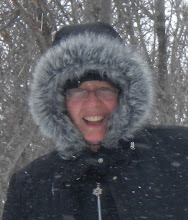
That is me--trying to trudge through the snow. It may look like I'm laughing, but trust me--I'm not. Not long after this was taken, I announced I was done, and sat down--which wasn't hard, since I didn't have far to sit.
A few days ago, I decided it would be a good idea to go and check the rabbit traps. There happened to be a blizzard raging at the time, but I was very insistent.
But since I’m still recovering from the tweaked knee and jammed shoulder I got from the last time I went skiing, I decided to just walk along while Keri and Taco skied.
There are several lessons I learned from this little jaunt into the great outdoors:
1. It is much easier to stay up on top of the snow when on skis. Boots tend to sink down—sometimes to the hips.
2. Skis move much faster than boots—especially if the boots are three feet or more below the surface of the snow.
3. My boots are not waterproof.
4. Snow can somehow work its way inside ski pants.
5. I get very grumpy when trying to wade through deep snow.
6. Sometimes I have really dumb ideas.
We have eight traps spread out in an area about a quarter square mile—and we have to go about half mile to get there. That may not sound like much walking, but when you consider that it involves trudging through deep snow in hurricane winds, and having to make your way bent over under low growing trees, it can feel like quite a trek. And this particular trip was especially grueling.
In frustration, I finally started crawling on all fours trying to stay on top of the snow. By the time we were half done, I was completely undone. I refused to move another step. I’m not sure what I thought I was going to do out there in the freezing weather—maybe wait for spring? But I was pooped. So Keri said he would ski home and come back with the snow-go. (That is what the locals call a snow machine.)
Taco and I huddled in the trees, next to the frozen rabbit we’d caught, and tried staying out of the worst part of the storm. It seemed to take forever, but Keri finally flew up on the snow-go. We climbed on, holding Taco’s skis on one side and his poles on the other, stuck the frozen rabbit between us, and took off. We looked like knights of the north, carrying our lances as we head off for the joust.
One thing about our rabbit-hunting grounds is that in order to get home, we have to cross the airstrip. That wouldn’t be a problem, except for the mountains of snow surrounding it. To keep the airstrip functional, the thing is grated after every storm, and the mounds of snow are over six feet tall in places. Add to that fresh powder, and you’ve got a rather intimidating snow machine ride. Taco and I were a little nervous. Keri used his “Aw—we should be fine” routine, but we didn’t buy into it. And a good thing too. The first major hill, and the snow-go started slipping and sliding. Then it went into a roll. But the first bit of a tip onto its side, and Taco and I shot off of the seat like wound up springs. We did NOT want to get trapped underneath a snow machine. We took the skis, poles, and dead frozen rabbit with us—and landed in a crumpled heap. It looking like a garage sale gone wrong. Once we were off, Keri was able to get the machine upright again—but it took a lot of coaxing to get me back on.
We finally made it home with no more problems—but the next day I found a big honking bruise on my leg. It’s my Queen of Stupid badge.
Taco in the storm we were in.
Keri coming back from checking the trap. We have to bend over to get through the trees. The piece of plastic bag tied to the tree is what we put up to mark the path so we can find the trap again.
That is me--trying to trudge through the snow. It may look like I'm laughing, but trust me--I'm not. Not long after this was taken, I announced I was done, and sat down--which wasn't hard, since I didn't have far to sit.
Subscribe to:
Posts (Atom)